2014년 6월 25일 수요일
Kono statement review of Japan : despicable denial
The Japanese government has released its official report of origins of 1993 "Kono statement." In conclusion, the Japanese government announced that Kono statement was not soley based on historical evidence. Rather, they concluded that the wording of the apology was the product of negotiation between Seoul and Tokyo.
This drew ire from Seoul and Beijing.
The cabinet secretary Yoshihide Suga insisted that Tokyo has no intention to change Kono statement and Tokyo will uphold the statement. Yes, Japan did not change the statement.
BUT let's take a look at Japan's conclusion:
"Kono statement was a product of negotiation between Seoul and Tokyo."
It is contradictory for the Japanese government to make such conclusion while Japan insisted to uphold the statement.
Japan did not investigate to seek the truth, rather Japan tried to hide the truth and withdraw their apology. If Japan had really intended to apologize to the victims, Japan would not have reviewed Kono statement.
From Japan's conclusion, it seems clear that Japan has no intention to apologize to the victims.
Abe's administration should remember that truth can never be hidden. Such distortions only make matters worse. It only shows Japan's bald-faced denial of history.
Reference: http://thediplomat.com/2014/06/japanese-report-on-the-kono-statement-draws-ire-from-seoul-beijing/

2014년 5월 13일 화요일
Papers prove Japan forced women into Second World War brothels, says China
Some historians believe as many as 200,000 women were sent to frontline to be sexually abused between 1932 and 1945

Japanese women hold portraits of Chinese, Philippine, South Korean and Taiwanese former 'comfort women' who were sex slaves for Japanese soldiers during the Second World War. Photograph: Toru Yamanaka/AFP
China has released documents it claims offers “ironclad proof” that the Japanese military forced Asian women to work in frontline brothels before and during the Second World War. Almost 90 documents from the archives of the military police corps-part of Japan’s Kwantung army, the occupying force that propped up a puppet regime in Manchuria in the early 1930s – include letters from Japanese soldiers, newspaper articles and military files discovered in the 1950s and kept at the Jilin provincial archives in north east-China.
The 25 previously confidential files relating to sex slaves include reports, telephone records and documents mentioning the sexual enslavement, according to Chinese media. Other documents give details of the Nanking massacre, in which Japanese soldiers killed as many as 300,000 people during their 1937-1938 occupation of Nanking(now Nanjing), according to Chinese and western historians.
Chinese state media speculated that the publication was in response to repeated claims by conservative politicians that the women were not coerced by government authorities or the military.
Abe: issue of military comfort women cannot be described in words
Japanese Prime Minister Shinzo Abe has vowed to continue explaining his country's stance on the comfort women issue, after U.S. President Barack Obama last week described Japan's wartime system of sex slavery as "a terrible violation of human rights." According to a report by Japan’s Kyodo news agency Sunday, Abe said words cannot describe what the women went through and that it’s heartbreaking to think about it.
-Does he really mean it? We’ll see.
Japan may repeat history it denies
On eve of visit by the U.S. president, Abe’s record is recounted

Prime Minister Shinzo Abe, center, is led by a Shinto priest as he visits the Yasukuni Shrine in Tokyo on Dec. 26, 2013. He was the first prime minister to do so in seven years. [REUTERS/NEWS1]
Last Dec.26 Abe paid respects at the controversial Yasukuni Shrine in Tokyo, which enshrines Class-A war criminals among its war dead, as it is viewed as a symbol of Japan’s militarism and denial of its colonial brutalities.
While he was serving as prime minister for one year from 2006 to 2007, he provoked international outrage when he made remarks as “There is no evidence to probe there was coercion of women in to sexual slavery.” After international criticism, his government issued an apology later the same month.
On March 14, Abe for the first time he will uphold the 1993 Kono Statement acknowledging and apologizing for the forced recruitment of women as sex slaves by Japanese military. Yoon Mee-hyang, co-head of Korean Council for the Women Drafted for military Sexual Slavery by Japan said the recent Japanese actions are more as a gesture to the U.S. ahead of President Barack Obama’s visit, rather than actually wanting a resolution to the issue.”
Japan expert Nam Sang-gu, a senior researcher at Northeast Asian History Foundation, a state-run research institute said the Japanese government needs to acknowledge its forced mobilization of women into sexual slavery “as a national crime” and offer official reparations to make the apology non-retractable.
Nam said he anticipated that Abe in his 70th anniversary statement on Aug 15. 2015, will follow Koizumi’s lead and may leave out the phrase “through its colonial rule and aggression,” which he has been hesitant to use in the past.

Comfort women deserve a memorial: their ordeal must not be forgotten
"My mother was forced into sexual slavery by the Japanese military. To hear the Japanese prime minister say 'comfort women' were voluntary prostitutes is shocking."

Jan Ruff O’Herne, the author's mother. Photograph: Greg Weight
Author Carol Ruff’s mother Jan Ruff O’Herne was a former “comfort woman” or sex slave during World War II. Three weeks ago her mother was featured in The Age newspaper in response to a state by Prime Minister Abe of Japan, who declared “comfort women” were all voluntary prostitutes. However, her mother was not a voluntary prostitute. When she was 21 years old, she was taken away and forced into sexual slavery by Japanese military. For 50 years, she told no one of her war-time experiences, but after she saw Korean war-rape victims making appeals for justice in 1992, she finally spoke out and spent 15 years fighting for the rights of women in war and armed conflict.
“Women are often forgotten heroes of the war. The pain and humiliation of sexual servitude is great. This proposed statue is not a vindictive act towards Japanese people. It is a gesture towards reconciliation healing of the wounds of the World War II. Only through truth can we move forward and learn from the past.” Carol said.
2014년 5월 12일 월요일
In The Fight To Vindicate The Comfort Women, Ordinary Americans Upstage U.S. Tokyo Ambassador Caroline Kennedy
Few days ago, I posted an article (http://blog.naver.com/hapchang2014/60213876101) that the Chicago-based Mayer Brown is withdrawing from the case calling for a removal of comfort women statue in Glendale. Mayer Brown was probably reacting to coruscating criticism from such well informed legal experts as Ken White, a prominent Log-Angeles-based criminal attorney, and Marc Randazza, a First Amendment lawyer.
The important lesson from this case is that although early hopes that the Internet would prove a powerful tool for a good have been dashed, it still can help the ordinary decent American public win out at a time while many elite Americans including Caroline Kennedy, have gone AWOL on Japanese neo-fascism.
Caroline Kennedy, the daughter of John F. Kennedy, serves as President Barack Obama’s ambassador to Japan. She could have announced that any move by Japan to “unapologize” would be viewed with dismay in the United States. She has been all but silent.
For more details, check the website below.
What is Kono statement?

Kono statement refers to a statement which admits Japanese military had been indirectly or directly involved in the establishment of comfort stations during World War II. Kono statement was issued by the chief cabinet secretary Yohei Kono in 1993.
The statement has been a controversial issue among conservatives in Japan. Nationalist politicians claimed that Kono statement is a fabrication and therefore Abe should review the statement. However, the Japanese government recently announced that the government will uphold the statement in response to an intensive criticism by Korea and China. Yet Abe sparked controversy by visiting Yasukuni shrine which honors Japan’s war dead.
Only sincere apology can reconcile between Japan and other countries. Below is the Kono statement.
Statement by the Chief Cabinet Secretary Yohei Kono
on the result of the study on the issue of "comfort women"
August 4, 1993
The Government of Japan has been conducting a study on the issue of wartime "comfort women" since December 1991. I wish to announce the findings as a result of that study.
As a result of the study which indicates that comfort stations were operated in extensive areas for long periods, it is apparent that there existed a great number of comfort women. Comfort stations were operated in response to the request of the military authorities of the day. The then Japanese military was, directly or indirectly, involved in the establishment and management of the comfort stations and the transfer of comfort women. The recruitment of the comfort women was conducted mainly by private recruiters who acted in response to the request of the military. The Government study has revealed that in many cases they were recruited against their own will, through coaxing coercion, etc., and that, at times, administrative/military personnel directly took part in the recruitments. They lived in misery at comfort stations under a coercive atmosphere.
As to the origin of those comfort women who were transferred to the war areas, excluding those from Japan, those from the Korean Peninsula accounted for a large part. The Korean Peninsula was under Japanese rule in those days, and their recruitment, transfer, control, etc., were conducted generally against their will, through coaxing, coercion, etc.
Undeniably, this was an act, with the involvement of the military authorities of the day, that severely injured the honor and dignity of many women. The Government of Japan would like to take this opportunity once again to extend its sincere apologies and remorse to all those, irrespective of place of origin, who suffered immeasurable pain and incurable physical and psychological wounds as comfort women.
It is incumbent upon us, the Government of Japan, to continue to consider seriously, while listening to the views of learned circles, how best we can express this sentiment.
We shall face squarely the historical facts as described above instead of evading them, and take them to heart as lessons of history. We hereby reiterated our firm determination never to repeat the same mistake by forever engraving such issues in our memories through the study and teaching of history.
As actions have been brought to court in Japan and interests have been shown in this issue outside Japan, the Government of Japan shall continue to pay full attention to this matter, including private researched related thereto.
Source:
2014년 4월 30일 수요일
Comfort Women Animation "Her story"
This animation was produced with actual victims’ voices of Japanese military slavery. This video was based on Chung, Seo-Woon’s story. She was born in a wealthy family in Jeollanam-do Hadong. Japanese authority confiscated all the brass-ware from each household, he dug the ground and buried them, so he was imprisoned. One day, the town foreman told her that if she works at the factory in Japan for about two years, her father will be released from the prison the same day before she leaves to Japan. Not knowing the truth, she volunteered to go to Japan to release her father from the prison. However, her father was not released and he passed away in the prison. She was not even taken to Japan. She was taken to Indonesia and she was raped several times when she was only 15. Whenever she resisted, Japanese injected opium to her and she became addicted to opium. There was no hope but only misery. She even committed suicide, but failed. She came back home after Korean Independence Day, but nobody was at home. She was the first former Korean comfort woman who stood up and told her stories.
I would like to finish with quotes by her.


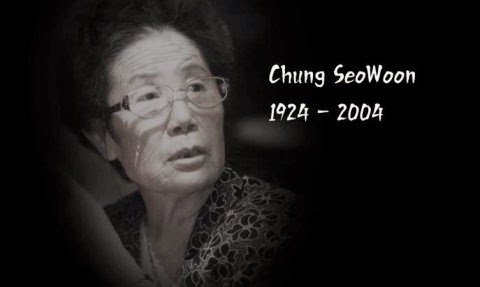
“I kept telling myself that I just have to stay alive. They may have killed my body, but not my spirit. That is how I survived.”
피드 구독하기:
글 (Atom)