레이블이 sex slavery인 게시물을 표시합니다. 모든 게시물 표시

2014년 6월 12일 목요일

The 1130th Wednesday Demonstration


 Every Wednesday, the Wednesday demonstration is held in front of the Japanese embassy in Seoul. Yesterday (11/06/2014) was the 1130th Wednesday demonstration, and it was my second time to join the Wednesday demonstration.

 Unlike the last time(28/05/2014), halmonis (Korean word for "Grandmother") came to the demonstration. Lee Yong-su halmoni and Kim Bok-dong halmoni joined the demonstration.

 Few days ago, another victim of military slavery by Japan passed away. Now there are only 54 victims alive in Korea. About 20 years ago, there were 234 former comfort women alive, but now there are only 54 victims alive. Unfortunately, halmonis are not healthy. Most of them are very old and they are not in good health. They are running out of time. Every second is a countdown.

 Many people joined the demonstration including halmonis, citizens, Korean council, journalists, foreigners, and the late Bae chun-hui halmoni. 


  Lee Yong-su halmoni stood up in front of the people, cried out and sent her last message to the late Bae chun-hui halmoni. Some people started to cry when halmoni said Bae's name out loud. I had mixed feelings of sadness and anger. I felt so sad because Bae halmoni passed away before the Japanese government makes an official apology. When will the Japanese government make formal and sincere apologies to halmonis? It seems like the government is hesitating to make a formal apology. They should admit and apologize without hesitation.


 After the protest, I approached Lee Yong-su halmoni and sent my message. I told her to cheer up and stay healthy. Halmoni held my hands with her warm hand and said she is happy because people, especially students, still remember the victims and fight for the victims. Oh, I was so moved. I approached her to cheer her up, but her warm words and her hands cheered me up instead. I can still feel the warmth of her hand.


                             Halmoni, I love you and thank you so much. I support you 
                                                                   R.I.P Bae Chun-hui 


2014년 6월 7일 토요일

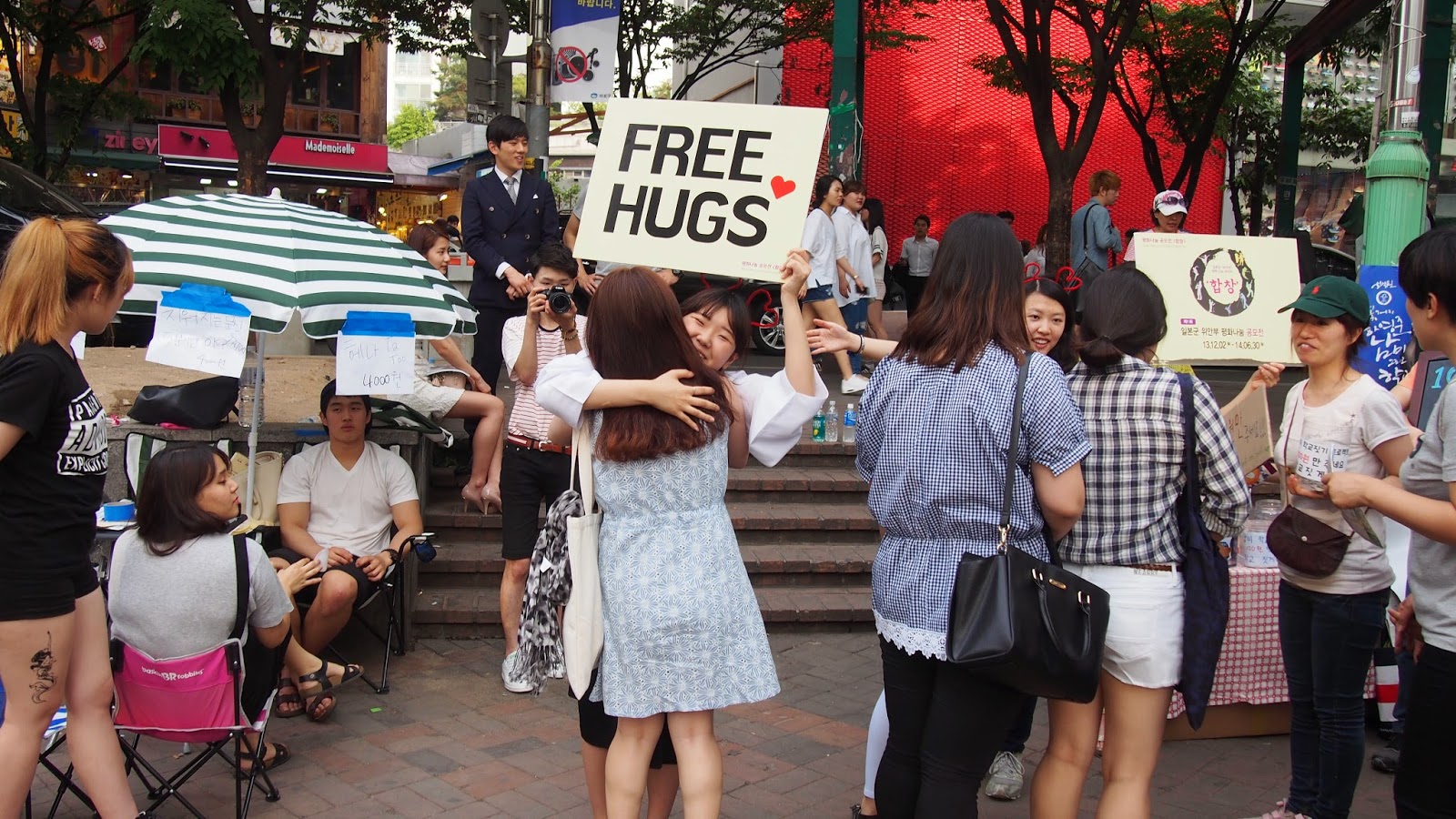
Free Hugs&Holding Hands event @Hongdae


 On May 31st, team 'Hapchang' held a special event at 16:30-18:30 near Hongik University street, Seoul, Korea. We offered "Free Hugs&Holding Hands" and gave Heeum bracelet.  The event was aimed at promoting contest 'Hapchang', spreading love, and raising social awareness about the victims of military sexual slavery. 17 staffs took part in this event and more than 200 citizens joined our event. Huge thank you for those who joined our event. Your simple gesture has brightened our day.  
 Personally, it was a very special experience because it was my first time to organize an outdoor event. At first I was afraid, but thanks to our wonderful staffs and kind citizens, our event was a huge success. 


One of the best FreeHugs pics <3
 There was also another meaningful event nearby, collecting 100 won to help build a school in Latin America. For the last thirty minutes, the two meaningful groups joined together. 


Granny 
We love you and we won't forget you!


After joining the Wednesday demonstration


 On May 28th was the 1128th Wednesday demonstration. For those who want to know more about the 'Wednesday demonstration', click here. Our team joined the 1128th Wednesday demonstration. 

  The Wednesday demonstration is held on every Wednesday at noon in front of the Japanese embassy in Seoul. It is hosted by Korean council. Victims desperately want justice. It has past 22 years since the first demonstration in 1992.

You can take the Seoul metro line 3 to "Anguk" station and take exit 1 or exit 6. The Japanese embassy is within 10 minutes walking distance from the station. Anyone can join the Wednesday demonstration.


​ Many people joined the Wednesday Demonstration. There were high school students, university students, foreigners, photographers etc. Students were holding signs written "Bring dignity to the victims!", "Official apology!" "There is no future for a nation who has forgotten their history" and so on. 


 This is a statue dedicated to the victims of military sexual slavery by Japan. The victims had gone through terrible and miserable times when they were young as the girl from the statue. What can you see from her face? I can see her anger and sadness. With clenched fists on her laps, she is sitting and looking quietly toward the Japanese embassy.
 If you take a close look at the statue, the girl's hair is not the same length all around. Her unevenly cut hair shows the abrupt break from her family and home. The bird sitting on her shoulder represents freedom and peace. The bird is also a spiritual bridge that links us and the ​victims who have already passed away. The chair next to her is open to anyone so that people can sit right next to her at the same position as the women being remembered. ​The shadow of the statue looks like an old lady. This symbolizes the victims today. Also, it symbolizes the past and present is still connected.


  Some participants shared their thoughts. I was deeply impressed by their speech. I was moved by the Japanese ladies' speech. They also sang Korean traditional song "Arirang", and it was very touching.
 ​It was meaningful to join the Wednesday Demonstration. There is still hope because many people still remember ​the truth. Young students and even foreigners remember the truth, and they raised their voice for the victims.


2014년 5월 18일 일요일

What is Murayama Statement?


Murayama statement is a statement that apologizes the damage and suffering caused by Japan. Below is the Murayama statement.


Statement by Prime Minister Tomiichi Murayama
"On the occasion of the 50th anniversary of the war's end"
(15 August 1995)


 The world has seen fifty years elapse since the war came to an end. Now, when I remember the many people both at home and abroad who fell victim to war, my heart is overwhelmed by a flood of emotions.
The peace and prosperity of today were built as Japan overcame great difficulty to arise from a devastated land after defeat in the war. That achievement is something of which we are proud, and let me herein express my heartfelt admiration for the wisdom and untiring effort of each and every one of our citizens. Let me also express once again my profound gratitude for the indispensable support and assistance extended to Japan by the countries of the world, beginning with the United States of America. I am also delighted that we have been able to build the friendly relations which we enjoy today with the neighboring countries of the Asia-Pacific region, the United States and the countries of Europe.
Now that Japan has come to enjoy peace and abundance, we tend to overlook the pricelessness and blessings of peace. Our task is to convey to younger generations the horrors of war, so that we never repeat the errors in our history. I believe that, as we join hands, especially with the peoples of neighboring countries, to ensure true peace in the Asia-Pacific region -indeed, in the entire world- it is necessary, more than anything else, that we foster relations with all countries based on deep understanding and trust. Guided by this conviction, the Government has launched the Peace, Friendship and Exchange Initiative, which consists of two parts promoting: support for historical research into relations in the modern era between Japan and the neighboring countries of Asia and elsewhere; and rapid expansion of exchanges with those countries. Furthermore, I will continue in all sincerity to do my utmost in efforts being made on the issues arisen from the war, in order to further strengthen the relations of trust between Japan and those countries.
Now, upon this historic occasion of the 50th anniversary of the war's end, we should bear in mind that we must look into the past to learn from the lessons of history, and ensure that we do not stray from the path to the peace and prosperity of human society in the future.
During a certain period in the not too distant past, Japan, following a mistaken national policy, advanced along the road to war, only to ensnare the Japanese people in a fateful crisis, and, through its colonial rule and aggression, caused tremendous damage and suffering to the people of many countries, particularly to those of Asian nations. In the hope that no such mistake be made in the future, I regard, in a spirit of humility, these irrefutable facts of history, and express here once again my feelings of deep remorse and state my heartfelt apology. Allow me also to express my feelings of profound mourning for all victims, both at home and abroad, of that history.
Building from our deep remorse on this occasion of the 50th anniversary of the end of the war, Japan must eliminate self-righteous nationalism, promote international coordination as a responsible member of the international community and, thereby, advance the principles of peace and democracy. At the same time, as the only country to have experienced the devastation of atomic bombing, Japan, with a view to the ultimate elimination of nuclear weapons, must actively strive to further global disarmament in areas such as the strengthening of the nuclear non-proliferation regime. It is my conviction that in this way alone can Japan atone for its past and lay to rest the spirits of those who perished.
It is said that one can rely on good faith. And so, at this time of remembrance, I declare to the people of Japan and abroad my intention to make good faith the foundation of our Government policy, and this is my vow.


Japan Is Still Denying the Sexual Slavery of Chinese 'Comfort Women'


Chinese and Malayan girls forcibly taken from Penang
by the Japanese to work as 'comfort girls' for the troops
image from Wikipedia

​ 
For 70 years, Japan has denied the "comfort women". It is estimated that nearly 400,000 girls from Korea, China, Philippines were enslaved in total. According to researcher, C. Sarah Soh, author of "The Comfort WomenSexual Violence and Postcolonial Memory in Korea and Japan," the comfort women system was viewed as a way "to control the troops through regulated access to sex." Still, the victims are suffering from deep psychological trauma, as well as headaches, memory loss, and other associated physical and  medical problemsDr. Peipei Qiu, author of "Chinese Comfort Women: Testimonies from Imperial Japan's Sex Slaves," says "If the historical truth is not told, the same thing could happen again." Regardless of opponents' claims, Qiu says the survivor testimonies provide a powerful counter narrative to the Japanese denial. The truth cannot be hidden. 


"​If the historical truth is not told, the same thing could happen again." 


House of sharing


image source: www.nanum.org/eng 


​ "House of sharing" is the home for living former comfort women who were forced into Japanese military slavery during World War II. The House of sharing committee was founded in June 1992 with the purpose of building a home for the living comfort women through raising funds from Buddhist organizations and various circles of society.
 Every Wednesday, they participate in the "Wednesday Protest" in front of the Japanese Embassy in Seoul. As of August 2008, there are seven former comfort women living in the house, and there are full time staff members including the director, Won-Haeng, a Buddhist Priest.
 For those interested, visit the website http://www.nanum.org/eng


December, 1991
* Buddhism society issued a statement on Comfort Women with a Buddhist Priest, Hye-Jin who worked as a director at Korea Comfort Women Issue Countermeasure Committee
October, 1992
* Inauguration of the House of Sharing
* Buddhism Human Rights Committee, Directed by Song, Wal-Joo, organized volunteers from various fields to open the House of Sharing in order to build a home for comfort women in Mapo-Gu, Seocho-Dong in Seoul. 
1993~1995
* The House of Sharing moved to Myung-ryun dong and then to Hae-Wha Dong.
August, 1995
* Construction started on the House of Sharing in Gyung-gi Do, Gwang-ju Goon, Taechon-Myun, Won-dang Lee. The area of the house was about 180-pyung. (approximately 720 square yards) The land was donated by Ms. Cho, Young-Ja.
December, 1995
* Comfort women started to move-in.
February, 1996
* Finished construction of a high-way ramp to the House of Sharing and held a ceremony with Premiere Lee Soo-Sung.
September, 1996
* Held an exhibition tour of “Drawings by Comfort Women” in Japan for about one hundred days
October, 1996
* Launched an internet website about comfort women through Hankook Daily News internet website.
(http://www.hk.co.kr/event/jeonshin/e_homepage.htm)
November, 1996
* Received a social welfare organization license for the House of Sharing from the government of Kyung-ki Province.
February, 1997
* Construction started on the Japanese Military’s Comfort Women Historical Museum, contributed by Dae-Dong, Co.
March, 1997
* Construction started on the Japanese Military갽s Comfort Women Historical Museum, contributed by Dae-Dong, Co.
April, 1997
* Comfort women’s Seventieth birthday party celebrated, sponsored by Korea Broadcasting Service.
June, 1997
* Comfort woman “Hoon” from Cambodia visited the House of Sharing in order to understand the current situation of comfort women in Korea.
August, 1997
* Comfort woman “Hoon” returned to her home country from Korea. She stayed at the House of Sharing during the visit.
October, 1997
* A campaign, called “3000 persons’ museum promotion”, started as a fund-raiser to collect exhibits for the museum.
December, 1997
* Committee for the preparation of the Comfort Women Historical Museum started.
August, 1998
* Concert for the comfort women at the House of Sharing by Ms. No, Young-Sim. (A popular singer in Korea)
* The Comfort Women Historical Museum opened.
October, 1999
* Reported the construction of residences for the welfare of elderly to the government of Kyung-ki Province.
March, 2001
* Buddhist priest Neung-Gwang started his post as the director of the House of Sharing.
Currently in 2002
* Nine comfort women reside at the House of Sharing including comfort woman Kim, Soon-duk.
History of "House of sharing" 
[출처] House of sharing|작성자 공모전 합창

2014년 5월 15일 목요일

S. Korea, Japan set to resume sex slavery talks


 South Korea and Japan were to resume director-general level talks in Tokyo on Thursday to discuss the Japanese army's sexual enslavement of Korean women during World War II. 


The meeting will be mainly focused on the sex slavery issue, but other topics may be also brought up such as North Korea and Japan's move to exercise the right to collective self-defense, according to government officials.

In April, Seoul and Tokyo agreed to hold director-general level talks over the sex slavery issue on a regular basis at their first official consultations.