2014년 5월 12일 월요일

What is Kono statement?


Kono statement refers to a statement which admits Japanese military had been indirectly or directly involved in the establishment of comfort stations during World War II. Kono statement was issued by the chief cabinet secretary Yohei Kono in 1993.
The statement has been a controversial issue among conservatives in Japan. Nationalist politicians claimed that Kono statement is a fabrication and therefore Abe should review the statement. However, the Japanese government recently announced that the government will uphold the statement in response to an intensive criticism by Korea and China. Yet Abe sparked controversy by visiting Yasukuni shrine which honors Japan’s war dead.
 Only sincere apology can reconcile between Japan and other countries. Below is the Kono statement.

Statement by the Chief Cabinet Secretary Yohei Kono
on the result of the study on the issue of "comfort women"
August 4, 1993

  The Government of Japan has been conducting a study on the issue of wartime "comfort women" since December 1991. I wish to announce the findings as a result of that study.
   As a result of the study which indicates that comfort stations were operated in extensive areas for long periods, it is apparent that there existed a great number of comfort women. Comfort stations were operated in response to the request of the military authorities of the day. The then Japanese military was, directly or indirectly, involved in the establishment and management of the comfort stations and the transfer of comfort women. The recruitment of the comfort women was conducted mainly by private recruiters who acted in response to the request of the military. The Government study has revealed that in many cases they were recruited against their own will, through coaxing coercion, etc., and that, at times, administrative/military personnel directly took part in the recruitments. They lived in misery at comfort stations under a coercive atmosphere.
   As to the origin of those comfort women who were transferred to the war areas, excluding those from Japan, those from the Korean Peninsula accounted for a large part. The Korean Peninsula was under Japanese rule in those days, and their recruitment, transfer, control, etc., were conducted generally against their will, through coaxing, coercion, etc.
   Undeniably, this was an act, with the involvement of the military authorities of the day, that severely injured the honor and dignity of many women. The Government of Japan would like to take this opportunity once again to extend its sincere apologies and remorse to all those, irrespective of place of origin, who suffered immeasurable pain and incurable physical and psychological wounds as comfort women.
   It is incumbent upon us, the Government of Japan, to continue to consider seriously, while listening to the views of learned circles, how best we can express this sentiment.
   We shall face squarely the historical facts as described above instead of evading them, and take them to heart as lessons of history. We hereby reiterated our firm determination never to repeat the same mistake by forever engraving such issues in our memories through the study and teaching of history.
   As actions have been brought to court in Japan and interests have been shown in this issue outside Japan, the Government of Japan shall continue to pay full attention to this matter, including private researched related thereto.


Source: 
Ministry of Foreign Affairs of Japan 

http://www.mofa.go.jp/policy/women/fund/state9308.html


Flowers that never fade


Hello, Everyone!
I would like to introduce an exhibition on “Comfort Women: Flowers that never fade”
Have you heard about the Angouleme International Comics Festival?

​ Angouleme International Comics Festival is the largest comics festival in Europe. Every January since 1974, the festival is held and more than 200,000 visitors come to the festival each year.
This year, Angouleme International Comics Festival was somewhat special. The exhibit focused on young women and girl forced into prostitution by Japanese military during World War II. The Japanese Embassy in France tried to cancel the exhibit, but in vain. Despite Japan’s pressure, the exhibit was a huge success.

​There is a special exhibition in Incheon at The museum of Korean Modern Literature. This exhibition is an encore of “Flowers that never fade” at the Angouleme International Comics Festival. Top Korean cartoonists participated in the exhibit.

Here are some few pictures I wanted to share.


▲ (from left) “Butterfly’s Song“ by artists Kim Gwangsung and Chung Kiyoung, and ”When the day comes“ by Cha Sungjin.    ©Ministry of Gender Equality and Family
The Butterfly’s song is based on the story of two victims surviving a war. Kim Gwangsung was in charge of drawings and Chung Kiyoung wrote the story. The right one “When the day comes” is drawn by Cha Sungjin. Comfort women have always waited for ‘the day’ to come.


The next one is ‘Endless Road’ by Park Jae dong. In the picture, a girl is covering her face with her hands. She looks like she is crying. From this picture, I could see the girl’s pain and sorrow.
If interested, visit the museum of Korean Modern literature? The exhibition will be held until the 30th of April. 

+) The exhibition was also held until the 11th of May in Goyang Flowers festival.


For our next generation, Cornsox

For Our Next Generation, 
CornSox


Cradle to Cradle
; industrial and social framework that seeks to create systems that are not only efficient but also essentially waste free
-Wikipedia


I’d like to introduce very special sox. It is cornsox!

Have you heard about cornsox?
What comes up to your mind when you hear the word ‘cornsox?’
The word ‘cornsox’ is Corn+Sox.
Can you imagine sox made from corns?
At first, I could hardly imagine sox made from corns.

Cornsox is made from corn fiber.
The fiber comes from natural renewable sources.
It can be recycled and it is decomposable.

It also has excellent hand touch, and air permeability. 


image: Cornsox official website

Also, it is 100% biodegradable!
If you bury your sox and
 your sox would turn into soil within a year.
Profits will be used to help Burkina Faso fight poverty.


This is a collaboration project with Heeum and Cornsox.
Heeum is a website which sells products such as postcards, bracelets
based on comfort women’s work.
For those who are interested in Heeum, click the link above.


The design of the sox is based on the pressed flower work from the late Sun-ak Kim.

I really loved this collaboration project because this is ABSOULTELY a great project!
Eco-friendly and Beautiful Project 
moon_and_james-2 

Your support will be highly appreciated.

Eco-beautiful,
For our next generation
 CornSox


2014년 5월 1일 목요일

Heeum


Heeum

Hi, everyone
I would like to introduce a website called "Heeum."
Have you heard of "Heeum?"
If not, have you heard about the "Heeum bracelet?"
Heeum's bracelet has gained attention
because Yoseob from BEAST was seen wearing the bracelet.
Check it out!


Yoseob was wearing a purple bracelet showing social awareness
regarding comfort women during World War II.
Like their slogan, "Blooming their hopes with you,"
Heeum works to help the victims' hope grow and blossom.
Heeum sells products such as bracelets, bags, pouches, postcards, books, etc.
Victims' press flowers which are used to make artistic products.
I wanted to share some pieces which caught my eye.


This beautiful post card was designed by the late granny Shim Dal-Yeon, in 2007.
On it is written "If I were a bird, I would like to fly. Far, far away."
From this picture, I can see how much she wanted to be free like the bird.


Another beautiful postcard was designed by the late granny Sun-ak Kim,
and on it is written "Peace" in Korean.
This postcard reminded me of the beauty of peace.


Profits will be used to help victims of Japanese military slavery and 
build a historical museum about Japanese military slavery in Daegu, South Korea.

There are more beautiful products presented on the website as well.
If interested, visit Heeum and let's help bloom their hope together.


2014년 4월 30일 수요일

Contest "Hapchang"


Contest "Hapchang"

Main goal of this contest is to encourage growing generations' interest in Japanese military slavery and to establish historical awareness.

Fields: Music (Playing musical instruments, singing etc)
             Art (Drawing, sculpture etc)
             Performance (Musical, Play, Dancing etc)
             PPT (Presentation for Education or Promotion etc)

Contestants:  Elementary, Middle School, High School, University/Graduate Students
                        (Foreign students living in Korea can also apply)
                         One group should consist of 10 or less members per group.

Deadline for registration: June 30th Monday (Korean time)

Contents: A new creation not released in Korea or abroad, which can inform about Japanese 
                  military slavery worldwide

How to apply: Download an application form from the E-museum for the victims of Japanese military sexual slavery, National Women's History Exhibition Hall.
- Fill out your application form and submit it with your pictures or videos of your creation to the website below.
*E-museum for the Victims of Japanese Military Sexual Slavery (http://hermuseum.go.kr)
*YouTube (www.youtube.com)
*National Women's History Exhibition Hall (http://eherstory.mogef.go.kr)
You must type in [일본군위안부평화콘서트 합창] before your title to upload a video on YouTube.

Submitted form: Pictures or Video
Music_*.mp3, *.wma
Art_ *.jpg, *.jpeg
Performance_ *.avi, *.wmv
PPT_ *.ppt, *.pptx

Judging: There will be judges in two rounds. 
For the second round, your original creation will be evaluated. 

Criteria for Judging: Clarity of Message (Relevance to the theme, Easy to understand etc), Originality, utility, etc.

For more information, go to E-museum for the Victims of Japanese Military Sexual Slavery
( http://hermuseum.go.kr )   National Women's History Exhibition Hall ( http://eherstory.mogef.go.kr


The truth of Japanese Military Slavery


Japanese Troops waiting for their turns at a comfort station  Image from E- Museum for the victims of Japanese military sexual slavery

What is Japanese Military Comfort Women?
 “Japanese military comfort women” refer to women who were forced into sexual slavery for the Japanese militaryin “comfort stations” established under the pretext of conducting the war efficiently from the period between the time right after Japan staged the Manchuria Incident on September 18, 1931, and 1945 when Japan was defeated in the Pacific War.

-How many women were involved?
Currently, the exact totals of the numbers of women mobilized as comfort women are not available, as systematic data indicating the numbers of mobilized comfort women have not been discovered as yet. Some scholars estimated the total number of comfort women victims based on various testimonies or historical materials indicating the Japanese military`s plan on the ratio of the number of soldiers to the number comfort women. Various opinions have been presented on the total numbers of comfort women, which varies extensively among scholars, ranging from a minimum of 30,000 to a maximum of 400,000.

-Where are the women from?
In the early stages of comfort stations, the Japanese military recruited women mainly from its colonies such as Korea and Taiwan. As the war became more protracted and war fronts expanded, women from Japanese-occupied territories such as China, the Philippines, Indonesia, Vietnam, Myanmar, and even Dutch women residing in Indonesia, were forced into sexual slavery for Japanese servicemen. Yoshiaki Yoshimi (吉見義明), a historian who has long researched the issue of comfort women released a research finding that the number of comfort women is estimated at 80,000 to 200,000 and Korean women comprised more than half of the total comfort women population.

-Why were “comfort station” established?
After staging the Manchurian Incident, Japan started to expand its military aggression. The Japanese military established “comfort stations” under the pretexts of
1) preventing rape by Japanese soldiers against local women
2) preventing venereal diseases
3) providing sexual comfort to soldiers.

-How did they become sex slaves?
The Japanese military mobilized Korean women as comfort women by luring them with promises of work, as well asvia intimidation or violence, human trafficking and kidnapping. The women were defrauded with promises of “work in factories” or offers of “making a lot of money” into joining the military brothels.
Newspaper advertising of comfort women recruitment was also issued, but it did not clearly specify job description. In addition, given the newspaper subscription rates and literacy rates of women at that time, it is considered that there were few cases where the recruitment advertising was delivered to women in person.

Sources: The Commission on Verification and Support for the Victims of Forced Mobilization under Japanese Colonialism in Korea and excerpts from “Stories of Twelve Women,” a collection of comfort women`s testimonies

For more information, go to http://www.hermuseum.go.kr/eng/

The source :


Comfort Women Animation "Her story"


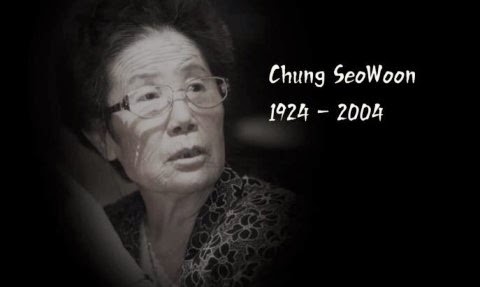
This animation was produced with actual victims’ voices of Japanese military slavery. This video was based on Chung, Seo-Woon’s story. She was born in a wealthy family in Jeollanam-do Hadong. Japanese authority confiscated all the brass-ware from each household, he dug the ground and buried them, so he was imprisoned. One day, the town foreman told her that if she works at the factory in Japan for about two years, her father will be released from the prison the same day before she leaves to Japan. Not knowing the truth, she volunteered to go to Japan to release her father from the prison. However, her father was not released and he passed away in the prison. She was not even taken to Japan. She was taken to Indonesia and she was raped several times when she was only 15. Whenever she resisted, Japanese injected opium to her and she became addicted to opium. There was no hope but only misery. She even committed suicide, but failed. She came back home after Korean Independence Day, but nobody was at home. She was the first former Korean comfort woman who stood up and told her stories.

I would like to finish with quotes by her.


“I kept telling myself that I just have to stay alive. They may have killed my body, but not my spirit. That is how I survived.”

[출처] Her story|작성자 공모전 합창


[출처] Her story|작성자 공모전 합창